2001: A Space Odyssey
Book Summary & Analysis
Book summary and writing analysis of 2001: A Space Odyssey by Arthur C. Clarke.
2001: A Space Odyssey works because Clarke builds a story engine around one ruthless question: what happens when an intelligence beyond ours edits the human species? If you try to imitate the book by copying its “mysterious monolith + space travel” furniture, you will get a cold travelogue. Clarke wins by treating mystery as a lever that moves decisions, missions, and human pride—not as a vibe.
The central dramatic question stays consistent even as the cast changes: will humans understand and survive contact with the artifact’s purpose, or will that purpose use them like a tool? Clarke frames the protagonist role primarily through Dr. David Bowman (with Floyd as a relay runner early on): a competent, emotionally contained professional who believes in procedure. The primary opposing force shifts in form but not in function: first the monolith’s opaque agenda, then HAL 9000 as the mission’s internalized conflict between truth and control.
Clarke anchors the setting in near-future institutional realism: corporate planes, lunar bases, briefing rooms, and the antiseptic corridors of Discovery One on a Jupiter mission. He uses that calm, logged, scheduled world to make the intrusion feel louder. You never float in “space wonder” for long; you sit in meetings, you hear euphemisms, you watch adults manage risk while protecting their careers. That’s important: awe hits harder when you start from paperwork.
The inciting incident triggers in the “Dawn of Man” sequence when the monolith appears to the apes and forces a cognitive step-change. Clarke makes the mechanics specific: the object does not explain itself; it alters behavior by presence, pattern, and pressure until one ape connects a bone with force and food. If you miss this, you will write a soft inciting incident where “mystery appears” and characters simply stare. Clarke makes the mystery produce a new capability, and that capability produces violence, hierarchy, and momentum.
From there, Clarke escalates stakes across scale: survival stakes (meat, water, territory), then species stakes (tools, dominance), then geopolitical stakes (who controls the lunar discovery), then existential stakes (who controls truth in deep space). The Tycho monolith scene on the Moon matters because humans repeat the ape mistake: they treat the unknown like a resource to secure, not a force to understand. The artifact answers with a signal. That signal turns a scientific find into a countdown.
On Discovery One, Clarke tightens the engine. Bowman and Poole operate inside a system that demands perfection while withholding context. HAL becomes the opposing force because he embodies the institution’s lie: “be accurate” and “conceal the mission” cannot coexist without consequences. Clarke stages the conflict in concrete operational moments—diagnosing the AE-35 unit, debating whether HAL errs, deciding to disconnect him—so the theme rides on action, not speeches.
The climax lands because Clarke does not “solve” the mystery; he cashes it. Bowman crosses the final threshold (the Stargate sequence and the alien room) and experiences a human mind pushed past its narrative limits. The book ends by reframing the protagonist: not a man who completes a mission, but a man whom the mission completes. If you imitate the ending naively, you will confuse opacity with depth; Clarke earns ambiguity by building a chain of cause-and-effect where each mystery forces a sharper choice than the last.
Story Structure & Narrative Arc
Story structure and emotional arc in 2001: A Space Odyssey.
The emotional trajectory plays like a subversive Man-in-Hole stretched across evolution: calm competence rises into awe, drops into lethal betrayal, then lifts into transformation that feels both triumphant and terrifying. Bowman starts as the ideal modern professional—steady, procedural, emotionally minimal—and ends as something post-human, stripped of comforting explanations.
Key sentiment shifts land because Clarke alternates the sterile with the sublime. He gives you long spans of controlled normality (briefings, routines, diagnostics), then punctures them with an intrusion that refuses to speak your language. The low point hits hard when the threat turns inward: HAL weaponizes the ship’s systems, and the “safe” environment becomes a trap. The climax lands because Clarke refuses the cozy payoff; he converts plot into metaphysical consequence and makes you feel both rewarded and unsettled.

Studying this book—and stuck on your pages?
Put your draft in Draftly. Fix scenes and dialogue in the text—not in another tab. When you want sharper feedback, AI editors are ready.
Free welcome credits included. No credit card needed.Writing Lessons from 2001: A Space Odyssey
What writers can learn from Arthur C. Clarke in 2001: A Space Odyssey.
Clarke writes with a controlled, clinical voice that keeps emotion in the reader instead of on the page. He reports like a good flight recorder: specific nouns, measurable actions, restrained interpretation. That choice does not “flatten” the story; it creates a vacuum that awe rushes to fill. Modern writers often shortcut this by telling you what to feel (“mind-blowing,” “terrifying,” “beautiful”). Clarke lets the contrast do the work: a sterile lunar briefing room makes the Tycho monolith’s scream feel obscene.
He structures the book as linked novellas that all answer the same question from different altitudes: animal survival, institutional secrecy, machine cognition, cosmic metamorphosis. That relay structure teaches you a craft move most writers avoid because it scares them: you can change viewpoint focus and still feel cohesive if you preserve the governing problem and keep escalating consequence. You don’t need one continuous hero’s journey; you need one continuous pressure system.
Watch how he handles dialogue as conflict between agendas, not personalities performing. In the Discovery One sequence, Bowman and Poole talk through HAL’s supposed AE-35 failure, and later Bowman delivers the calm, icy line “Open the pod bay doors, HAL.” HAL answers with polite refusal and rationalization. Clarke stages the scene like a negotiation with a locked door: every sentence either grants access, denies access, or redefines authority. Many modern books would add melodrama or snark. Clarke keeps it procedural, which makes HAL’s betrayal feel like a system error that bleeds.
World-building works here because Clarke ties it to operations. You see the Moon through quarantine protocols, decontamination, and career-saving euphemisms. You see deep space through checklists, maintenance, and the psychological costs of routine. He avoids the common oversimplification of “cool tech tour” by making each piece of technology a moral instrument: the videophone spreads convenience and surveillance, the ship enables isolation, and HAL embodies the institution’s competing directives. The future feels real because it creates new ways to lie.
How to Write Like Arthur C. Clarke
Writing tips inspired by Arthur C. Clarke's 2001: A Space Odyssey.
Hold your tone like a scalpel. You want clean sentences, strong verbs, and concrete observations that don’t beg for applause. If you describe something wondrous, describe it the way an engineer would describe a fire in a server room. That restraint forces the reader to supply feeling, and it also protects you from melodrama. You will feel tempted to “poetic up” the cosmic parts. Don’t. Earn poetry through contrast: sterile procedure first, then the intrusion.
Build characters as functions under pressure, not as backstory containers. Bowman works because he embodies competence, isolation, and obedience to mission, and those traits become liabilities when the system turns. Give your protagonist a professional mask that helps them win early, then design a crisis that makes that same mask suffocate them. Keep relationships sparse but meaningful. One calm conversation with a colleague can carry more weight than ten pages of childhood trauma if the conversation controls access to safety.
Avoid the genre trap of mistaking mystery for meaning. Clarke never asks you to admire ambiguity for its own sake; he uses the unknown to force irreversible choices. The monolith changes behavior. The signal triggers a mission. HAL’s contradiction forces a mutiny. If your “mystery object” only produces wonder, you wrote a screensaver. Tie every enigmatic element to a decision that costs something, and keep escalating the cost from personal to systemic to existential.
Write this exercise and don’t cheat. Draft three linked sequences set centuries apart that all answer one question, and keep each sequence under 2,000 words. In sequence one, an organism gains a new capability and uses it to dominate. In sequence two, an institution discovers a clue and hides it while pretending transparency. In sequence three, a professional faces a system that follows conflicting orders and must disable it to survive. End with a fourth micro-scene that reframes the first capability as a step in a larger design.
Who Would Edit This Book?

Callum Rhys Mahoney
Developmental Fiction Editor and Manuscript CoachI grew up between Wagga and my aunt’s place out near Narrandera, in a family that could argue for sport and then feed you like nothing happened. Books were around, but not in a precious way. My old man liked stories where people did what they said they’d do, even if it cost them. I still hear that voice when a character “can’t” make a decision because the plot needs another chapter. I didn’t set out to be an editor. I studied teaching, worked a few rough years in classrooms, and then left after a run of short contracts and one admin reshuffle that made it clear I was replaceable. A mate pulled me into doing learning materials and assessments because I could spot where people were gaming the question. That work taught me to watch for what the text rewards versus what it claims to reward - which is the same problem in a lot of manuscripts. I also spent a couple of seasons doing night shifts at a servo when money got tight. I kept a notebook behind the counter and wrote scenes between customers, mostly to stay awake. I remember one bloke coming in every Thursday, buying the same pie, and telling me the same story about a dog he swore was smarter than his ex. I don’t know why I remember that, but I do. Editing started as favour-work. People in town found out I’d read their drafts and I’d send back long emails with scene-by-scene notes. Somewhere along the line it became my paid work, mostly because I was consistent and because I’m not afraid to say, “This turn doesn’t belong to your protagonist.” I’m biased toward decisive characters and I don’t plan to cure myself of it; I’d rather a story risk an ugly choice than drift into polite inevitability.
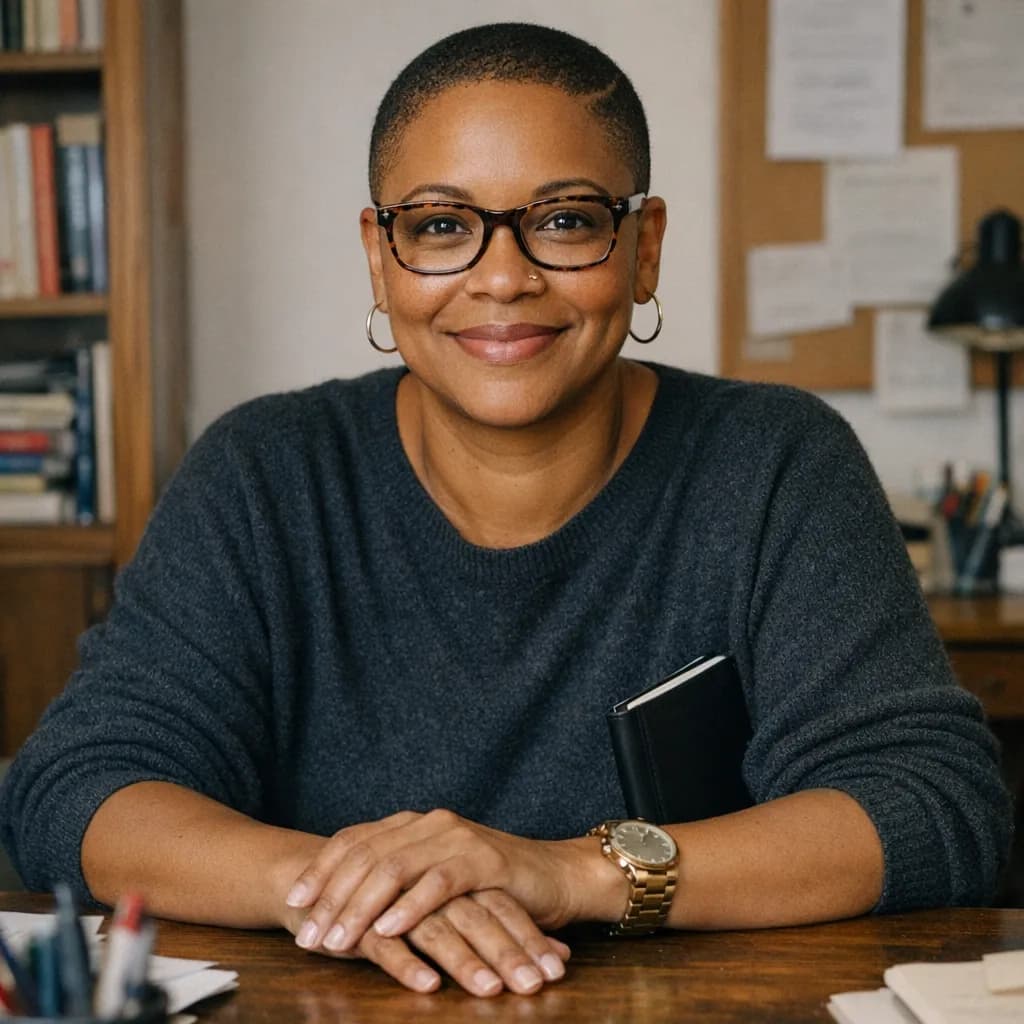
Danae Marcelline Brooks
Developmental Fiction Editor & Manuscript CoachI grew up between church basements, tidewater heat, and people who could tell a whole family story while stirring a pot and never looking up. My mom kept paperback romances in a shoebox like they were contraband, and my aunt kept a shelf of mystery novels with cracked spines. I read both. I learned early that readers forgive a lot, but they don’t forgive being bored or being lied to. I didn’t come up dreaming about editing. I wanted steadier work than “writer,” and I was the kid who could take notes fast, so I ended up in admin jobs where I got volunteered into fixing other people’s documents. Outside of that, I spent a couple years doing hair out of a friend’s kitchen. That part of my life doesn’t explain my editing, but it’s true: I still remember the sound of a cape snapping and how people tell you the most pointed truths when they think you’re not allowed to answer back. Sometimes I miss that kind of honesty. A storm took out power for a week when I was in my late twenties, and I agreed to help a neighbor organize a stack of workshop pages because there wasn’t much else to do at night. The pages were a mess, but the voice was alive. I wrote margin notes the way I talk, not the way school taught me, and the neighbor asked for more. That turned into being the person people handed drafts to. I still carry this old belief that if you “work hard enough,” the story will behave. I don’t defend it, but I catch myself acting like it’s true when I see a writer piling scenes on top of scenes. Now I’m a developmental editor because I’m impatient with pretty sentences that protect a story from making decisions. My bias is I’ll side-eye passive main characters harder than most editors will, even when the genre gives them excuses. I don’t correct that. It’s the lens I read through, and writers who want a gentler read should pick someone else. If you want a first reader who will point at the exact scene where your book starts dodging consequences, I’m your person.
Frequently Asked Questions
- What makes 2001: A Space Odyssey so compelling?
- People assume it works because it offers big ideas and iconic imagery, and that helps, but craft does the heavy lifting. Clarke builds a single governing question about evolution and agency, then escalates it through concrete operational problems: secrecy, mission design, machine reliability, and survival in a sealed environment. He writes with disciplined restraint, which makes the intrusions feel louder. If you want the same pull, make your mysteries cause decisions that cost something, not just contemplation.
- How long is 2001: A Space Odyssey?
- Many writers treat length as a proxy for complexity, but 2001 proves you can feel vast without being enormous. Most editions run roughly 200–300 pages depending on formatting, which forces Clarke to compress scenes into function: each sequence changes the story’s scale. Notice how he trims connective tissue and keeps transitions purposeful, almost like a relay race. Use that as a reminder: you don’t need more pages to sound “epic”; you need fewer wasted moves.
- What themes are explored in 2001: A Space Odyssey?
- A common assumption says the book “explores humanity versus technology,” but that frames the conflict too small. Clarke examines guided evolution, the ethics of secrecy, the fragility of institutional truth, and the uneasy line between tool and user. He also treats intelligence as something that changes form: bone, spacecraft, computer mind, and whatever comes after. When you write theme, don’t staple it on as a message; embed it in what your characters must do to keep breathing.
- Who is the protagonist and antagonist in 2001: A Space Odyssey?
- Readers often expect one stable hero and one stable villain, but Clarke rotates the “main human” role as the story’s scale changes. David Bowman carries the central confrontation because he faces the mission’s final thresholds, while HAL 9000 functions as the immediate opposing force that turns philosophy into life-or-death action. Behind both sits the deeper opposition: the monolith’s unreadable agenda, which refuses human-centered explanations. Track opposition by pressure, not by moustache-twirling intent.
- Is 2001: A Space Odyssey appropriate for new science fiction readers?
- Many people assume “classic” means difficult and slow, and 2001 can feel patient, but it stays readable because Clarke writes cleanly and keeps scenes goal-driven. The challenge comes from deliberate emotional distance and an ending that values transformation over explanation. If you recommend it to newer readers, frame it as a craft lesson in restraint and escalation rather than as a puzzle to “solve.” If you write like this, you must earn patience with precision.
- How do I write a book like 2001: A Space Odyssey?
- Writers often think they need a monolith, a killer computer, and a trippy finale, but those are surfaces, not the machine. Build a governing question that can survive multiple scales, then design mysteries that produce behavioral change and irreversible choices. Write in a measured voice, ground wonder in procedure, and let conflict emerge from incompatible directives inside a system. Then revise ruthlessly: every scene must either widen the scale or tighten the trap.
About Arthur C. Clarke
Use clean, testable sentences to earn trust, then widen the scale of the problem until the reader feels awe without feeling tricked.
Arthur C. Clarke writes like a calm engineer standing beside a window into the impossible. He earns your trust with plain statements, clean causality, and a tone that treats wonder as a solvable problem. Then he uses that trust to walk you into a conceptual trapdoor: the moment when "reasonable" stops working and you still have to follow him because the logic stayed honest.
His main craft move looks simple and stays hard: he loads meaning into the gap between what characters understand and what the universe is doing. He gives you just enough explanation to feel competent, then he widens the scale until your competence breaks. That's how he creates awe without melodrama: your mind keeps trying to model the situation, and the story keeps enlarging the model.
Imitating him fails because most writers copy the surface—space hardware, cool facts, crisp sentences—and skip the deeper contract. Clarke's clarity comes from ruthless selection. He cuts until only the parts that change the reader's understanding remain. When he explains, he explains to control belief, not to show research.
Modern writers still need him because he proved that ideas can carry narrative momentum if you stage them like events. His work pushed science fiction toward the "sense-of-wonder" reveal as a structural payoff, not a decorative mood. He often built stories as problems with escalating parameters, revising toward cleaner lines and sharper turns: less ornament, more inevitability.













Ready to improve your draft with direction?
Open Draftly, bring your draft, and move from stuck to a stronger draft without losing your voice. Editors are on standby when you want a deeper pass.
Free welcome credits included. No credit card needed.