Kindred
Book Summary & Analysis
Book summary and writing analysis of Kindred by Octavia E. Butler.
Kindred works because it turns time travel into a craft tool, not a premise. The central dramatic question never asks “Can Dana get home?” (she usually can). It asks a sharper, uglier thing: How much of yourself will you trade to keep someone else alive, and what will that bargain turn you into? Dana Franklin, a Black writer living in 1976 Los Angeles with her white husband Kevin, keeps getting yanked into early-19th-century Maryland whenever Rufus Weylin’s life tilts toward death. The primary opposing force is not “the past” in general. It’s the Weylin plantation system, embodied in Tom Weylin’s power and Rufus’s growing entitlement.
Butler builds the engine on a rule you can steal: each return trip functions like a forced-choice scene. Dana doesn’t travel because she wants knowledge. She travels because someone else triggers her, and she must decide whether to intervene. The inciting incident lands fast and concrete: Dana finds Rufus drowning in a river, drags him out, and then watches a white man level a gun at her for touching a white boy. In one beat, Butler hands you the stakes, the social physics, and the price of competence. Dana saves a life and nearly loses her own for it. If you try to imitate this book naively, you’ll chase “cool time travel moments.” Butler chases moral accounting.
Notice how Butler escalates stakes without inflating spectacle. The first trips teach Dana the rules: she appears near crisis, she returns when her own life hits immediate danger, and her modern knowledge only helps in narrow ways. Then the structure tightens. Each visit lasts longer. Each intervention sticks. Dana’s relationship to Rufus shifts from emergency rescuer to reluctant manager of his worst impulses, because her family line depends on his survival. That dependency creates a pressure cooker no chase scene can match.
The setting does more than provide atmosphere. Butler pins you to specific places that generate conflict on contact: the Weylin house where authority speaks softly and punishes loudly, the cookhouse and slave quarters where news travels as rumor and warning, the fields where labor turns into surveillance. Meanwhile 1976 Los Angeles doesn’t offer “safety,” it offers contrast. Dana and Kevin’s interracial marriage reads as ordinary in their home. In Maryland, it becomes an instant target, and Butler uses that target to remove the reader’s distance.
The stakes climb across a simple but ruthless staircase. First, Dana risks her life. Next, she risks Kevin’s. Then she risks her identity as a decent person. The more she understands the plantation’s logic, the more she must negotiate with it to keep people alive. Butler refuses the comforting fantasy that the protagonist can outsmart history with one heroic speech. Dana can patch injuries, teach a few people to read, and make tactical bargains. She cannot end the system. That limitation makes every choice feel sharp instead of symbolic.
Rufus functions as a living fuse. He starts as a frightened child Dana can save, then grows into a man who understands that she will keep returning for him. Butler turns that into the book’s most disturbing leverage: the antagonist learns the protagonist’s weakness and uses it. Dana doesn’t battle a mustache-twirling villain. She battles the gradual corruption of someone she once protected, and she battles the part of herself that keeps hoping she can steer him.
Butler also uses Kevin as a structural complication, not a romantic accessory. When Kevin gets stranded in the past for years, Butler forces Dana to face the plantation alone and forces Kevin to absorb the era without her buffering him. That separation prevents the modern couple from functioning as a single, all-capable unit. It also adds a second internal question: what happens to a marriage when one partner must survive by adapting to a regime the other can’t fully inhabit?
If you want to learn from Kindred, don’t copy its historical backdrop and call it “important.” Copy its pressure system. Butler chains cause-and-effect to a repeating mechanism, then tightens the chain each cycle. She makes every return trip costlier than the last, until the only way out requires a choice Dana can’t undo. That’s why the novel feels inevitable without ever feeling prewritten.
Story Structure & Narrative Arc
Story structure and emotional arc in Kindred.
Kindred follows a Man-in-a-Hole pattern with a twist: Dana starts with modern confidence and moral clarity, then each “rescue” drags her into deeper compromise. She ends with knowledge she didn’t ask for and wounds she can’t reinterpret as growth. The arc doesn’t reward bravery; it charges interest on every concession.
The story lands its low points because Butler times them to Dana’s learning curve. Early shocks teach rules. Mid-book turns punish the belief that competence can control the system. Later drops hit harder because Dana begins to anticipate cruelty and still can’t prevent it without becoming complicit. The climax doesn’t feel like “winning.” It feels like a final boundary Dana draws after the book proves what happens when she keeps erasing her own.

Studying this book—and stuck on your pages?
Put your draft in Draftly. Fix scenes and dialogue in the text—not in another tab. When you want sharper feedback, AI editors are ready.
Free welcome credits included. No credit card needed.Writing Lessons from Kindred
What writers can learn from Octavia E. Butler in Kindred.
Butler’s greatest trick looks simple: she writes clean, plain sentences while she tightens a vise. You never get ornate language to hide behind. That restraint forces you to watch the mechanics of power in real time. Dana narrates like a working writer: she observes, she estimates risk, she acts. Butler keeps the prose readable so the moral complexity can do the heavy lifting. If you reach for lyrical fog to sound “literary,” you’ll miss the point. Butler sounds calm so the events can sound insane.
She also builds character through coercion rather than backstory. Dana doesn’t “discover” who she is through inspirational reflection. She learns what she can tolerate, and the book records the cost of each tolerance. Rufus evolves in the most frightening realistic way: he doesn’t flip into villainy; he accrues permission. Watch how Butler stages Dana and Rufus’s conversations so he tests boundaries in increments. He asks, then expects, then demands. That progression teaches you how to write corruption as a process, not a costume change.
Dialogue does surgical work. In scenes where Dana tries to reason with Rufus about Alice, Butler lets him speak like someone who believes he feels love, which makes his control harder to dismiss. Dana answers with practical limits, not speeches, and the gap between their definitions of “care” becomes the conflict. You can study those exchanges as a template for writing arguments where both sides stay intelligible but only one side stays humane. Modern fiction often uses a shortcut here: it makes the antagonist obviously monstrous from page one. Butler makes him plausible first, then unbearable.
World-building lands because Butler anchors terror to ordinary spaces. The Weylin house doesn’t need gothic exaggeration; it needs routines, rules, and consequences that snap into place when someone crosses an invisible line. A cookhouse conversation, a quiet walk that becomes surveillance, a moment of medical help that turns into suspicion—each scene teaches the reader the environment’s “if/then” logic. Many writers summarize oppression as theme. Butler dramatizes it as logistics. That choice keeps the book from preaching and keeps you from looking away.
How to Write Like Octavia E. Butler
Writing tips inspired by Octavia E. Butler's Kindred.
Write with the steadiness Butler uses, not with a megaphone. Dana never narrates to prove she has the correct politics; she narrates to stay alive and to make sense of what survival costs. Keep your sentences clear, your images specific, and your emotional register controlled. If you raise your voice on the page, earn it with an irreversible action. And don’t confuse “flat” with “plain.” Plain voice still chooses what to notice, what to name, and what to refuse to romanticize.
Build characters as systems of leverage. Dana wants safety and integrity, but the story keeps paying her in one currency at the expense of the other. Rufus wants comfort, then control, then ownership, and each step feels “reasonable” to him because the world rewards it. Give every major character a desire that turns toxic under pressure. Then write scenes where they negotiate terms, not feelings. Track who holds the exit, who controls the food, who controls the story everyone repeats afterward.
Avoid the genre trap of treating the past as a theme park for misery or heroics. The worst version of this concept turns into a parade of atrocities with a modern protagonist delivering commentary between them. Butler refuses that. She binds violence to cause and consequence and forces Dana to make tactical choices inside a system she can’t fix. If you write historical harm, don’t use it as wallpaper for your character’s virtue. Make it a machine your character must understand, misread, and finally confront.
Try this exercise. Write a short story with a repeating “summons” mechanic like Dana’s: your protagonist gets pulled into a situation only when someone else reaches a crisis point. Give the summons a clear trigger and a clear escape condition that requires your protagonist to risk real harm. Each return trip must last longer and must leave a lasting mark that changes future negotiations. On the final trip, force a choice that stops the cycle but costs something the protagonist can’t recover.
Who Would Edit This Book?

Callum Rhys Mahoney
Developmental Fiction Editor and Manuscript CoachI grew up between Wagga and my aunt’s place out near Narrandera, in a family that could argue for sport and then feed you like nothing happened. Books were around, but not in a precious way. My old man liked stories where people did what they said they’d do, even if it cost them. I still hear that voice when a character “can’t” make a decision because the plot needs another chapter. I didn’t set out to be an editor. I studied teaching, worked a few rough years in classrooms, and then left after a run of short contracts and one admin reshuffle that made it clear I was replaceable. A mate pulled me into doing learning materials and assessments because I could spot where people were gaming the question. That work taught me to watch for what the text rewards versus what it claims to reward - which is the same problem in a lot of manuscripts. I also spent a couple of seasons doing night shifts at a servo when money got tight. I kept a notebook behind the counter and wrote scenes between customers, mostly to stay awake. I remember one bloke coming in every Thursday, buying the same pie, and telling me the same story about a dog he swore was smarter than his ex. I don’t know why I remember that, but I do. Editing started as favour-work. People in town found out I’d read their drafts and I’d send back long emails with scene-by-scene notes. Somewhere along the line it became my paid work, mostly because I was consistent and because I’m not afraid to say, “This turn doesn’t belong to your protagonist.” I’m biased toward decisive characters and I don’t plan to cure myself of it; I’d rather a story risk an ugly choice than drift into polite inevitability.
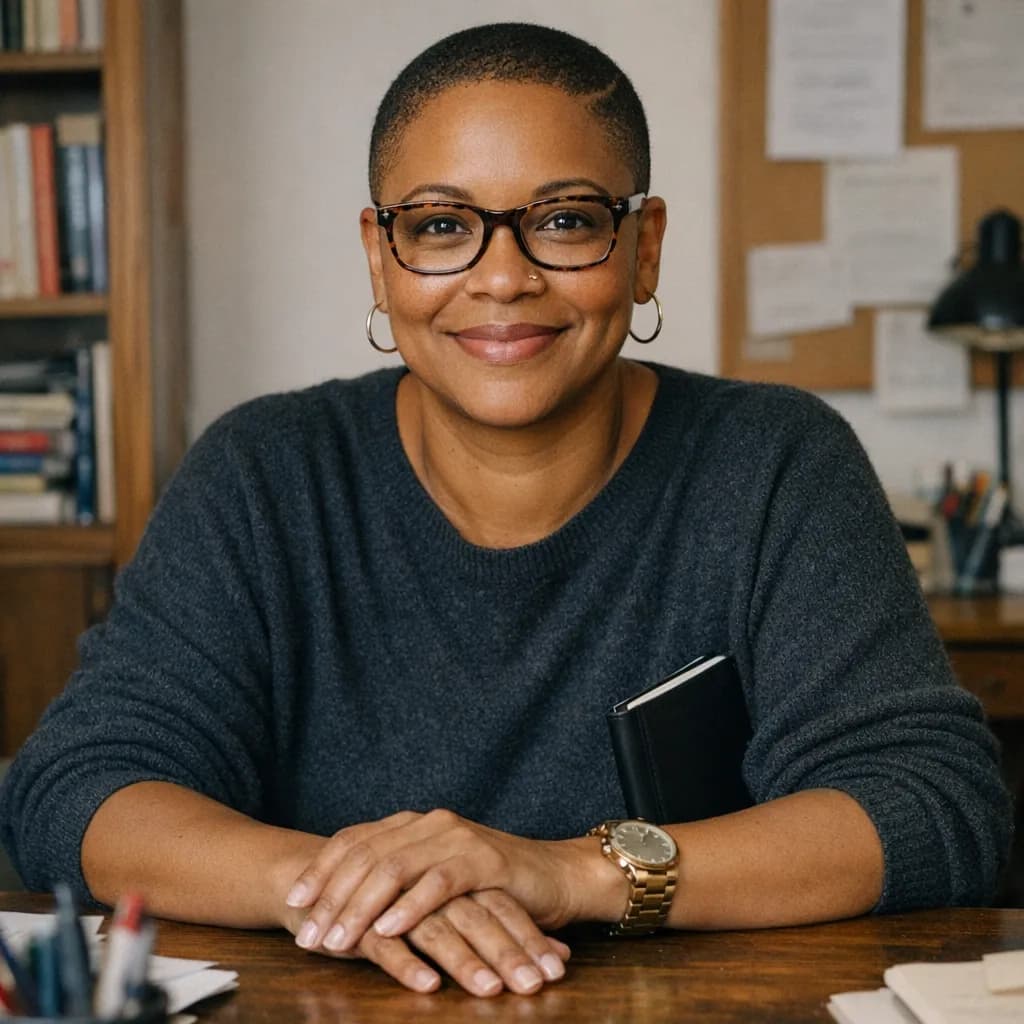
Danae Marcelline Brooks
Developmental Fiction Editor & Manuscript CoachI grew up between church basements, tidewater heat, and people who could tell a whole family story while stirring a pot and never looking up. My mom kept paperback romances in a shoebox like they were contraband, and my aunt kept a shelf of mystery novels with cracked spines. I read both. I learned early that readers forgive a lot, but they don’t forgive being bored or being lied to. I didn’t come up dreaming about editing. I wanted steadier work than “writer,” and I was the kid who could take notes fast, so I ended up in admin jobs where I got volunteered into fixing other people’s documents. Outside of that, I spent a couple years doing hair out of a friend’s kitchen. That part of my life doesn’t explain my editing, but it’s true: I still remember the sound of a cape snapping and how people tell you the most pointed truths when they think you’re not allowed to answer back. Sometimes I miss that kind of honesty. A storm took out power for a week when I was in my late twenties, and I agreed to help a neighbor organize a stack of workshop pages because there wasn’t much else to do at night. The pages were a mess, but the voice was alive. I wrote margin notes the way I talk, not the way school taught me, and the neighbor asked for more. That turned into being the person people handed drafts to. I still carry this old belief that if you “work hard enough,” the story will behave. I don’t defend it, but I catch myself acting like it’s true when I see a writer piling scenes on top of scenes. Now I’m a developmental editor because I’m impatient with pretty sentences that protect a story from making decisions. My bias is I’ll side-eye passive main characters harder than most editors will, even when the genre gives them excuses. I don’t correct that. It’s the lens I read through, and writers who want a gentler read should pick someone else. If you want a first reader who will point at the exact scene where your book starts dodging consequences, I’m your person.
Frequently Asked Questions
- What makes Kindred by Octavia E. Butler so compelling?
- Many readers assume the hook comes from time travel, but the compulsion comes from obligation. Butler designs a repeating rescue mechanism that forces Dana to intervene, then makes each intervention tighten Rufus’s leverage and the plantation’s control. The story stays gripping because every “solution” creates a new moral debt that comes due later, often in a worse form. If you want comparable pull, don’t hunt for bigger twists; build a cleaner cause-and-effect chain that punishes naive optimism.
- How does Kindred balance literary fiction with speculative structure?
- A common rule says speculative elements should get lots of explanation, but Butler keeps the mechanics spare and functional. She uses the time travel rule as a scene generator: appear at crisis, return under lethal threat, repeat with escalating consequences. That structure gives the book momentum while the prose stays grounded in sensory detail and social reality. When you try this blend, you don’t need more lore; you need stricter constraints that force hard choices.
- What themes are explored in Kindred?
- People often reduce the novel to “slavery is horrific,” which stays true but stays shallow. Butler explores how power reproduces itself through dependency, how intimacy can become a tool of control, and how survival can demand compromises that feel like betrayal. She also examines marriage across racial lines by testing Kevin and Dana’s unity under asymmetric risk. Treat theme as an outcome of repeated decisions, and you’ll keep your story from turning into an essay.
- Is Kindred appropriate for teens or sensitive readers?
- Many assume a classic novel will handle violence at a tasteful distance, but Butler refuses distance. The book includes racist violence, sexual coercion, and sustained threat because the narrative depends on consequence, not implication. That doesn’t make it exploitative; it makes it honest about the system’s daily enforcement. If you write for younger audiences, you can reduce explicitness, but you must keep the causal weight or the story turns performative.
- How long is Kindred by Octavia E. Butler?
- A common assumption says length predicts complexity, but Kindred proves structure does more work than page count. Most editions run roughly 260–300 pages, yet the book feels expansive because Butler cycles through escalating returns with lasting repercussions. Each trip functions like a compressed act that changes the next act’s terms. When you plan your own novel, measure not pages but how many times your protagonist must pay for earlier choices.
- How do I write a book like Kindred?
- Writers often think they should copy the premise—time travel into a brutal past—but premise won’t save you. Butler succeeds because she binds her protagonist to a repeating obligation, then escalates the cost until escape requires an irreversible boundary. Start by designing your “summons,” your escape condition, and the antagonist’s growing ability to predict and exploit your hero. Then draft scenes that show negotiation under constraint, and revise until every return changes the next one.
About Octavia E. Butler
Let scarcity force your characters into bargains. Dread arrives without a single speech.
Octavia E. Butler wrote like a calm engineer holding a live wire. She builds stories where the real action happens inside the reader's moral reflexes: who deserves care, who gets used, who gets to belong. She doesn't ask you to admire her ideas. She makes you live inside their consequences, then checks whether your old values still work.
Her engine runs on constraint. She puts a capable person into a social system that won't stay fair just because the protagonist tries hard. Power moves faster than virtue, and survival demands bargains. Butler's scenes turn on leverage: who has food, shelter, information, bodies, time. She keeps the language clean so the pressure reads as real, not theatrical.
Imitating her fails because you copy the premise instead of the control. The hard part isn't "speculative oppression" or "big themes." The hard part is pacing coercion without melodrama, and making terrible choices feel like the only choices. She earns dread through logistics and intimacy: needs, debts, touch, pregnancy, hunger, hierarchy.
Butler drafted with discipline and revised for clarity and force. She treated writing as scheduled labor, not inspiration, and she kept the prose serviceable so the structure could do the damage. Modern writers need her because she proved you can write page-turning speculative fiction that interrogates power without speeches—and without letting the reader off the hook.













Ready to improve your draft with direction?
Open Draftly, bring your draft, and move from stuck to a stronger draft without losing your voice. Editors are on standby when you want a deeper pass.
Free welcome credits included. No credit card needed.