Parable of the Sower
Book Summary & Analysis
Book summary and writing analysis of Parable of the Sower by Octavia E. Butler.
Parable of the Sower works because it doesn’t ask, “What happens next?” It asks, “What must a smart, frightened person become to stay alive—and what will it cost?” The central dramatic question stays brutally simple: can Lauren Olamina build a viable future out of a collapsing present without losing her humanity or her mind? Butler locks you into Lauren’s decision-making, then punishes every lazy belief you might bring into a disaster story: that preparation guarantees safety, that morality stays clean, that leadership looks heroic.
The setting does half the plot. Butler puts you in the 2020s outside Los Angeles, in a walled neighborhood that still pretends it counts as civilization. You see razor wire, scavengers, payday poverty, and the slow privatization of basics like water and security. The real genius: the “normal world” already carries apocalypse logic. That choice keeps the book from needing a big spectacle early. The pressure already lives in the price of a shower.
Lauren faces two main opposing forces that keep changing masks. One comes from outside: social collapse—arson, theft, predation, and the roaming poor who can’t afford to be gentle. The other comes from inside: complacency and denial, including her own community’s belief that walls equal safety and her father’s faith that duty will outrun chaos. Butler makes the enemy systemic, not a single villain, so every scene can carry threat without introducing a cartoon antagonist.
The inciting incident doesn’t arrive as a single thunderclap; it arrives as a refusal to keep pretending. Lauren creates Earthseed in secret and starts planning for escape while others plan for “things getting back to normal.” The precise mechanical trigger comes when she tests her readiness against reality—stockpiling, mapping routes, and making the private decision that she will leave if the neighborhood falls. Many writers imitate the later violence and miss this: the story turns when Lauren commits internally, not when the fires start.
Butler escalates stakes by stripping away layers of protection in a controlled sequence. First, the wall stops feeling permanent. Then the people inside the wall start acting like people under siege—fear, suspicion, bargains. Then the outside world stops behaving like “outside” and starts entering the home. When the neighborhood collapses in flames and Lauren flees, the book doesn’t “switch genres.” It cashes the promissory note Butler wrote in chapter one: safety was always rented.
Once Lauren hits the road, Butler converts ideology into action. Earthseed stops being pages in a notebook and becomes a leadership tool: a way to recruit, organize, and keep moving when grief and hunger make people stupid. Every addition to the traveling group raises both capability and risk. Each new person brings skills and also needs, history, and potential betrayal. That’s how Butler avoids the common post-apocalyptic flatline where the world stays dangerous but the story stops changing.
The structure keeps tightening because Lauren’s choices gain consequence. Early, she can fail privately. Later, her failure kills other people. Butler makes leadership feel like arithmetic under stress: food, water, shoes, guns, trust. The primary opposing force adapts too—thieves, rapists, slavers, and fire-obsessed “pyros” don’t appear as set pieces; they appear as predictable products of incentives in a broken economy.
If you imitate this book naïvely, you will copy the grimness and miss the mechanism that makes it move. Butler doesn’t stack tragedies for mood. She runs a controlled experiment on one character’s philosophy under worsening conditions, and she forces that philosophy to earn its keep. The point isn’t “everything gets worse.” The point is “your ideas either help you live, or they kill you faster.”
Story Structure & Narrative Arc
Story structure and emotional arc in Parable of the Sower.
The emotional trajectory looks like a hard Tragedy that mutates into a survival-driven rise. Lauren starts with constrained hope inside a fragile enclosure, convinced she can outthink disaster from behind a wall. She ends with scarred competence on open ground, carrying a belief system that no longer hides in private notes but steers real people toward a destination.
Butler earns the gut punches by timing them after moments of ordinary routine and small victories—community meetings, family conversations, a sense of managed danger. Each downturn doesn’t just increase peril; it erases an assumption the reader wanted to keep. The low points land because they feel preventable in hindsight, and the climactic movement lands because Lauren’s “answers” stay costly, incomplete, and still the best available option.

Studying this book—and stuck on your pages?
Put your draft in Draftly. Fix scenes and dialogue in the text—not in another tab. When you want sharper feedback, AI editors are ready.
Free welcome credits included. No credit card needed.Writing Lessons from Parable of the Sower
What writers can learn from Octavia E. Butler in Parable of the Sower.
Butler builds authority through form, not speeches. The journal entries let Lauren narrate with precision while still sounding like a teenager who learned to think like an analyst because the world forced her to. That voice buys Butler two powers at once: intimacy and compression. You can jump months without losing emotional continuity because the voice carries the throughline. Many modern dystopias lean on cinematic scene-after-scene and forget that a strong narrative lens can do more work than another chase.
She turns a “concept” into a plot engine by giving it teeth. Earthseed doesn’t sit on a shelf as theme. It creates decisions: whom Lauren trusts, how she frames risk, when she tells the truth, what she asks people to endure. Writers often treat philosophy as decoration—quotable lines between action beats. Butler treats belief as technology. If it doesn’t solve a problem today, it doesn’t belong on the page.
Watch how she handles dialogue as a contest of worldviews, not a delivery system for exposition. When Lauren talks with her father, Reverend Olamina, you don’t hear the author explaining collapse. You hear two survival strategies argue: his duty-bound insistence on holding the community together versus her preparation for inevitable breach. Butler lets subtext do the heavy lifting. Each line carries stakes because the relationship forces both speakers to protect pride while they negotiate fear.
Her world-building lands because she stages it in specific places with specific friction. You don’t learn “society has collapsed” from a paragraph of doom; you learn it when Lauren moves through the walled streets of Robledo, measures what people trade, and tracks which routines still function. Later, the road doesn’t feel like a generic wasteland because Butler keeps naming the costs—shoes, water, sleep, the price of appearing weak. Plenty of contemporary books shortcut this with a vague “grimdark tone.” Butler makes you feel the mechanisms, so the dread reads as realism, not mood.
How to Write Like Octavia E. Butler
Writing tips inspired by Octavia E. Butler's Parable of the Sower.
Write your narrator like someone who can’t afford to lie to themselves. Lauren’s voice stays controlled even when her life shreds, and that restraint makes the terror credible. Don’t try to imitate the calm by flattening emotion. Instead, show the control as effort. Let the narrator notice practical details under stress, then let one raw sentence slip through at the wrong moment. If your voice sounds “poetic” while the character starves, you will lose the reader’s trust.
Build characters as competing survival theories, not personality bundles. Lauren doesn’t lead because she owns the “leader trait.” She leads because she prepared, she observes, and she accepts costs other people refuse to accept. Give each major character a doctrine they live by, even if they never name it. Then make those doctrines clash in small decisions: when to share food, when to help a stranger, when to sleep. Change happens when a doctrine fails in public.
Avoid the genre trap of making collapse feel like a parade of bad news. Butler never uses misery as wallpaper. Each disaster removes an advantage and forces a new behavior. If you add violence, make it alter the operating rules of the story. If you introduce a threat, make it pressure the protagonist’s values, not just their body count. And resist the lazy “villain group” that exists only to be evil. Build predators from incentives and scarcity.
Run this exercise: write ten dated journal entries across three months of worsening conditions. In entry one, your protagonist believes one comforting lie about safety. In entry five, force a decision that tests that lie under time pressure. In entry ten, make them teach their updated belief to someone who doubts them, using only concrete examples from the last week. After you draft, cut every line that explains the theme. Keep only what your protagonist would write to survive tomorrow.
Who Would Edit This Book?

Callum Rhys Mahoney
Developmental Fiction Editor and Manuscript CoachI grew up between Wagga and my aunt’s place out near Narrandera, in a family that could argue for sport and then feed you like nothing happened. Books were around, but not in a precious way. My old man liked stories where people did what they said they’d do, even if it cost them. I still hear that voice when a character “can’t” make a decision because the plot needs another chapter. I didn’t set out to be an editor. I studied teaching, worked a few rough years in classrooms, and then left after a run of short contracts and one admin reshuffle that made it clear I was replaceable. A mate pulled me into doing learning materials and assessments because I could spot where people were gaming the question. That work taught me to watch for what the text rewards versus what it claims to reward - which is the same problem in a lot of manuscripts. I also spent a couple of seasons doing night shifts at a servo when money got tight. I kept a notebook behind the counter and wrote scenes between customers, mostly to stay awake. I remember one bloke coming in every Thursday, buying the same pie, and telling me the same story about a dog he swore was smarter than his ex. I don’t know why I remember that, but I do. Editing started as favour-work. People in town found out I’d read their drafts and I’d send back long emails with scene-by-scene notes. Somewhere along the line it became my paid work, mostly because I was consistent and because I’m not afraid to say, “This turn doesn’t belong to your protagonist.” I’m biased toward decisive characters and I don’t plan to cure myself of it; I’d rather a story risk an ugly choice than drift into polite inevitability.
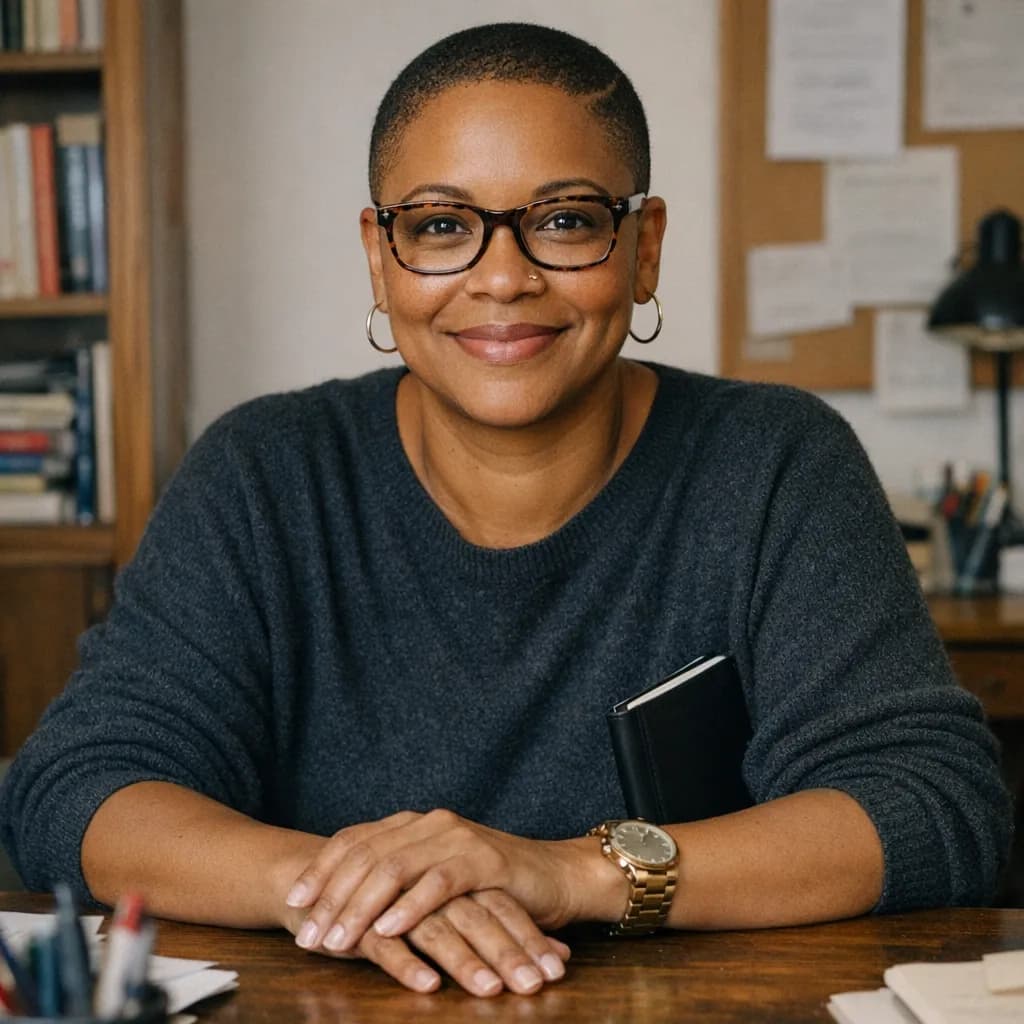
Danae Marcelline Brooks
Developmental Fiction Editor & Manuscript CoachI grew up between church basements, tidewater heat, and people who could tell a whole family story while stirring a pot and never looking up. My mom kept paperback romances in a shoebox like they were contraband, and my aunt kept a shelf of mystery novels with cracked spines. I read both. I learned early that readers forgive a lot, but they don’t forgive being bored or being lied to. I didn’t come up dreaming about editing. I wanted steadier work than “writer,” and I was the kid who could take notes fast, so I ended up in admin jobs where I got volunteered into fixing other people’s documents. Outside of that, I spent a couple years doing hair out of a friend’s kitchen. That part of my life doesn’t explain my editing, but it’s true: I still remember the sound of a cape snapping and how people tell you the most pointed truths when they think you’re not allowed to answer back. Sometimes I miss that kind of honesty. A storm took out power for a week when I was in my late twenties, and I agreed to help a neighbor organize a stack of workshop pages because there wasn’t much else to do at night. The pages were a mess, but the voice was alive. I wrote margin notes the way I talk, not the way school taught me, and the neighbor asked for more. That turned into being the person people handed drafts to. I still carry this old belief that if you “work hard enough,” the story will behave. I don’t defend it, but I catch myself acting like it’s true when I see a writer piling scenes on top of scenes. Now I’m a developmental editor because I’m impatient with pretty sentences that protect a story from making decisions. My bias is I’ll side-eye passive main characters harder than most editors will, even when the genre gives them excuses. I don’t correct that. It’s the lens I read through, and writers who want a gentler read should pick someone else. If you want a first reader who will point at the exact scene where your book starts dodging consequences, I’m your person.
Frequently Asked Questions
- What makes Parable of the Sower so compelling for writers?
- Many people assume the book works because it predicts the future or because it feels “dark but true.” The real craft hook comes from how Butler turns belief into a mechanism that generates choices under pressure: Earthseed drives recruitment, leadership, and risk tolerance. She also escalates stakes by removing protections in a deliberate order—home, community, anonymity, rest—so each chapter changes the rules. If you want that pull, track what advantage you take away next and what new behavior you force.
- How long is Parable of the Sower?
- A common assumption says page count equals “how much story” you need. This novel runs roughly in the mid-300-page range in many editions, but Butler earns momentum through tight entries, fast transitions, and scenes that double as world logic and character testing. Study how she compresses time without summarizing away consequence. Use length as a byproduct of escalation and decision density, not as a target you hit by inflating description.
- What themes are explored in Parable of the Sower?
- People often list themes as if they sit above the story like labels: change, community, religion, power, violence. Butler makes theme behave like a lever inside scenes. “God is Change” doesn’t function as a slogan; it functions as a tool Lauren uses to interpret loss and persuade others to move. If you want themes that read as inevitable, attach each one to a repeated choice and make that choice cost something each time.
- Is Parable of the Sower appropriate for young adult readers?
- Some assume a teenage protagonist automatically means the book fits YA expectations. Butler writes with adult severity: sexual violence, brutality, systemic cruelty, and the moral injuries of survival show up without soft focus. At the same time, Lauren’s voice stays clear and accessible, which can make the harshness feel even closer. If you write for younger readers, you must decide what you will depict on-page, what you will imply, and what emotional aftermath you will actually process.
- How does Octavia E. Butler build such convincing world-building in Parable of the Sower?
- Writers often think convincing world-building requires encyclopedic detail. Butler does the opposite: she chooses pressure points—water, walls, jobs, roads, fire—and shows how people behave when those systems fail. She anchors big collapse in small routines inside Robledo and later in the road’s daily arithmetic of food, sleep, and visibility. If your world feels thin, pick three necessities, decide who controls them, and dramatize the transactions instead of explaining history.
- How do I write a book like Parable of the Sower without copying it?
- A common misconception says you should copy the surface: journal format, dystopian California, roaming danger. Instead, copy the engine: give your protagonist a belief system that creates action, then stress-test it with escalating constraints that remove safety nets one by one. Make opposing forces systemic so threat can arise anywhere, including from “reasonable” people protecting their own comfort. When you draft, ask after every chapter what changed in the character’s operating rules—and if nothing changed, revise.
About Octavia E. Butler
Let scarcity force your characters into bargains. Dread arrives without a single speech.
Octavia E. Butler wrote like a calm engineer holding a live wire. She builds stories where the real action happens inside the reader's moral reflexes: who deserves care, who gets used, who gets to belong. She doesn't ask you to admire her ideas. She makes you live inside their consequences, then checks whether your old values still work.
Her engine runs on constraint. She puts a capable person into a social system that won't stay fair just because the protagonist tries hard. Power moves faster than virtue, and survival demands bargains. Butler's scenes turn on leverage: who has food, shelter, information, bodies, time. She keeps the language clean so the pressure reads as real, not theatrical.
Imitating her fails because you copy the premise instead of the control. The hard part isn't "speculative oppression" or "big themes." The hard part is pacing coercion without melodrama, and making terrible choices feel like the only choices. She earns dread through logistics and intimacy: needs, debts, touch, pregnancy, hunger, hierarchy.
Butler drafted with discipline and revised for clarity and force. She treated writing as scheduled labor, not inspiration, and she kept the prose serviceable so the structure could do the damage. Modern writers need her because she proved you can write page-turning speculative fiction that interrogates power without speeches—and without letting the reader off the hook.












Ready to improve your draft with direction?
Open Draftly, bring your draft, and move from stuck to a stronger draft without losing your voice. Editors are on standby when you want a deeper pass.
Free welcome credits included. No credit card needed.