My Name Is Red
Book Summary & Analysis
Book summary and writing analysis of My Name Is Red by Orhan Pamuk.
My Name Is Red works because it runs two irresistible questions on the same track and refuses to let you separate them. The obvious question sounds like a crime novel: who killed the miniaturist? The real question cuts deeper and lasts longer: can an artist remain faithful to love, faith, and patronage while the ground under his craft shifts? Pamuk builds a narrative machine where every answer exposes a new motive, and every motive rewrites the meaning of the evidence.
The inciting incident does not arrive as a vague “murder happens.” It arrives as a voice speaking from the bottom of a well. A dead man narrates his own death, and the book makes you accept his testimony as intimate, partial, and possibly strategic. In the same early movement, the Sultan’s commission for a secret illustrated book forces the workshop into a dangerous contradiction: paint in the old way to honor tradition, or adopt Frankish perspective and sign your work like a Westerner. That commission turns style into a liability. Now a brushstroke can incriminate.
Pamuk chooses Black as the protagonist not because he “solves” the case like a modern detective, but because he wants something that biases his attention. Black returns to Istanbul (1591) and moves through snow-choked streets, coffeehouses, and the cramped rooms where masters grind pigment and apprentices stretch paper. He wants Shekure, and he wants a place in the story she lives inside. That desire gives every interview a second agenda. You cannot fake that. If you copy the rotating narrators without giving your center character a hunger that corrupts his logic, you will write a clever shell.
The primary opposing force does not wear one face. It wears an argument. One side of it speaks through Enishte Effendi and the Sultan’s project: innovation, individuality, the lure of the new image. The other side speaks through the miniaturists’ fear of sacrilege and through the murderer who treats “style” as a signature that must vanish. Pamuk escalates stakes by tightening the noose around authorship itself. The closer the book gets to naming a killer, the more it asks whether naming anyone—signing, crediting, individuating—counts as a sin.
Structurally, Pamuk keeps the engine hot by switching the unit of suspense. Sometimes you chase the murderer. Sometimes you chase the marriage plot. Sometimes you chase a theological debate disguised as workshop gossip. That variety prevents fatigue, but it also teaches you something: each thread feeds the others. When Shekure negotiates protection and remarriage, she also negotiates whose story gets recorded, whose voice gets believed, and whose “proof” counts as proof.
The middle of the book does not rely on a single twist; it relies on a controlled leak of competence. Pamuk lets you watch masters read images the way a tracker reads footprints. They argue about a horse’s neck, a dog’s eye, a tree’s angle—small choices that reveal a hand. He turns craft talk into detective work, which means every scene of aesthetic debate doubles as plot movement. If you imitate this novel by writing long art lectures that do not change a decision, you will produce elegant stalling.
As the story drives forward, Pamuk raises costs on multiple fronts: political danger for the workshop, religious danger for the artists, and bodily danger for anyone who “knows too much.” Even comedy and folk-tale interludes carry threat, because the book keeps reminding you that a story can kill you when powerful people dislike the picture it paints. By the time Black closes in, the question stops being “Can he identify the killer?” and becomes “What will identification destroy—love, livelihood, faith, or the art itself?”
The novel “works” because Pamuk never lets the form become the point. The many voices do not exist to show off. They exist to dramatize a single pressure: in a world where images compete with doctrine and desire, every narrator edits reality to survive. If you try to copy Pamuk by stacking quirky narrators and winking at the reader, you will miss the discipline underneath. Pamuk earns each voice by attaching it to a stake, a fear, and a consequence.
Story Structure & Narrative Arc
Story structure and emotional arc in My Name Is Red.
Pamuk builds a hybrid of mystery and love story that behaves like a Man-in-a-Hole with an added moral trapdoor. Black starts as a competent outsider with a private longing and a public purpose, and he ends as an insider who pays for knowledge with complicity. The book shifts his goal from “return and reunite” to “choose what kind of truth you can live with,” which feels like progress and loss at the same time.
The biggest sentiment shifts land because Pamuk attaches them to choices, not revelations. Each time a character speaks, the voice carries both confession and self-defense, so even tender scenes feel edged. The lows hit hardest when the story turns craft into evidence: a flourish of style becomes a noose, and the reader realizes beauty can function like a fingerprint. The climax lands with force because it resolves the whodunit while refusing to soothe the larger wound: the culture war inside the image does not end just because you name the killer.

Studying this book—and stuck on your pages?
Put your draft in Draftly. Fix scenes and dialogue in the text—not in another tab. When you want sharper feedback, AI editors are ready.
Free welcome credits included. No credit card needed.Writing Lessons from My Name Is Red
What writers can learn from Orhan Pamuk in My Name Is Red.
Pamuk turns point of view into a courtroom, not a costume party. He rotates narrators so each chapter argues for a different model of truth: confession, accusation, folk tale, prayer, and sales pitch. He even lets “non-human” voices speak, which sounds like a gimmick until you notice the constraint: every voice fights for survival in the same contested city. You never float above the story as a neutral observer. You sit inside competing explanations and feel how belief forms.
He hides a craft manual inside a murder mystery by making technique actionable. The miniaturists do not merely “discuss art.” They use aesthetic rules to make decisions under threat, which makes those rules dramatic. When they argue about whether a master should repeat the old forms or risk Frankish perspective, the debate changes who trusts whom, who dares what, and who might kill to erase a signature. Many modern novels shortcut this by summarizing the theme in a paragraph of authorial wisdom. Pamuk makes you watch the theme cause behavior.
Notice how he handles dialogue between Black and Shekure. They do not trade “witty banter” or clean confessions. They negotiate. Shekure tests Black’s loyalty and usefulness while Black tries to sound honorable without surrendering leverage. Their scenes create suspense because each line carries two jobs: romance and risk management. If you write “romance subplot” scenes that do not change anyone’s safety, status, or next move, you will feel the air leave the book. Pamuk treats intimacy as strategy, so you lean in.
He builds atmosphere by treating Istanbul as an instrument panel, not a postcard. You feel the coffeehouse where storytellers perform, the workshop where pigments and gold leaf turn labor into devotion, the snow that muffles streets and isolates choices. He uses place to enforce secrecy and rumor: characters move through tight interiors where everyone hears everything, yet no one tells the whole truth. Many writers oversimplify world-building into encyclopedic detail. Pamuk uses concrete locations to control what characters can know, what they can hide, and what they must risk to learn more.
How to Write Like Orhan Pamuk
Writing tips inspired by Orhan Pamuk's My Name Is Red.
If you want polyphony, earn it. Give each narrator a bias you can summarize in one hard sentence, then let that bias distort what they notice and what they omit. Pamuk does not switch voices to show range; he switches to tighten pressure. Keep your prose clean and declarative, but let the personality sit in the choices of metaphor and the angle of judgment. And keep the humor dry. Use it as a blade, not a confetti cannon.
Build characters like Pamuk builds suspects. Start with a public role, then add a private need that conflicts with it, then add a belief they refuse to question. Black wants Shekure, but he also wants legitimacy in a world that measures men through craft and patronage. Shekure wants protection and agency inside constraints that punish direct desire. Do not “develop” characters by handing them a backstory paragraph. Make them choose in conversation, under time, with consequences.
Do not fall into the prestige-fiction trap of making everything ambiguous because ambiguity looks literary. Pamuk plays fair with information while keeping motives cloudy. He gives you concrete clues and specific procedures, then he lets ideology and desire muddy interpretation. If you copy the surface trick of many narrators without the underlying discipline of cause and effect, you will create noise. Clarity creates suspense. Confusion creates skim-reading.
Write one scene as a workshop interrogation where the evidence comes from craft, not fingerprints. Create three artists who all claim devotion to tradition. Give each a distinct “style tell” that appears in their work and in their speech rhythms. Let your investigator ask about a technical choice, and let the answer reveal a fear, not just a fact. Then rewrite the scene from two other viewpoints, each trying to look innocent while quietly accusing someone else. Keep every version pushing a different next action.
Who Would Edit This Book?

Callum Rhys Mahoney
Developmental Fiction Editor and Manuscript CoachI grew up between Wagga and my aunt’s place out near Narrandera, in a family that could argue for sport and then feed you like nothing happened. Books were around, but not in a precious way. My old man liked stories where people did what they said they’d do, even if it cost them. I still hear that voice when a character “can’t” make a decision because the plot needs another chapter. I didn’t set out to be an editor. I studied teaching, worked a few rough years in classrooms, and then left after a run of short contracts and one admin reshuffle that made it clear I was replaceable. A mate pulled me into doing learning materials and assessments because I could spot where people were gaming the question. That work taught me to watch for what the text rewards versus what it claims to reward - which is the same problem in a lot of manuscripts. I also spent a couple of seasons doing night shifts at a servo when money got tight. I kept a notebook behind the counter and wrote scenes between customers, mostly to stay awake. I remember one bloke coming in every Thursday, buying the same pie, and telling me the same story about a dog he swore was smarter than his ex. I don’t know why I remember that, but I do. Editing started as favour-work. People in town found out I’d read their drafts and I’d send back long emails with scene-by-scene notes. Somewhere along the line it became my paid work, mostly because I was consistent and because I’m not afraid to say, “This turn doesn’t belong to your protagonist.” I’m biased toward decisive characters and I don’t plan to cure myself of it; I’d rather a story risk an ugly choice than drift into polite inevitability.
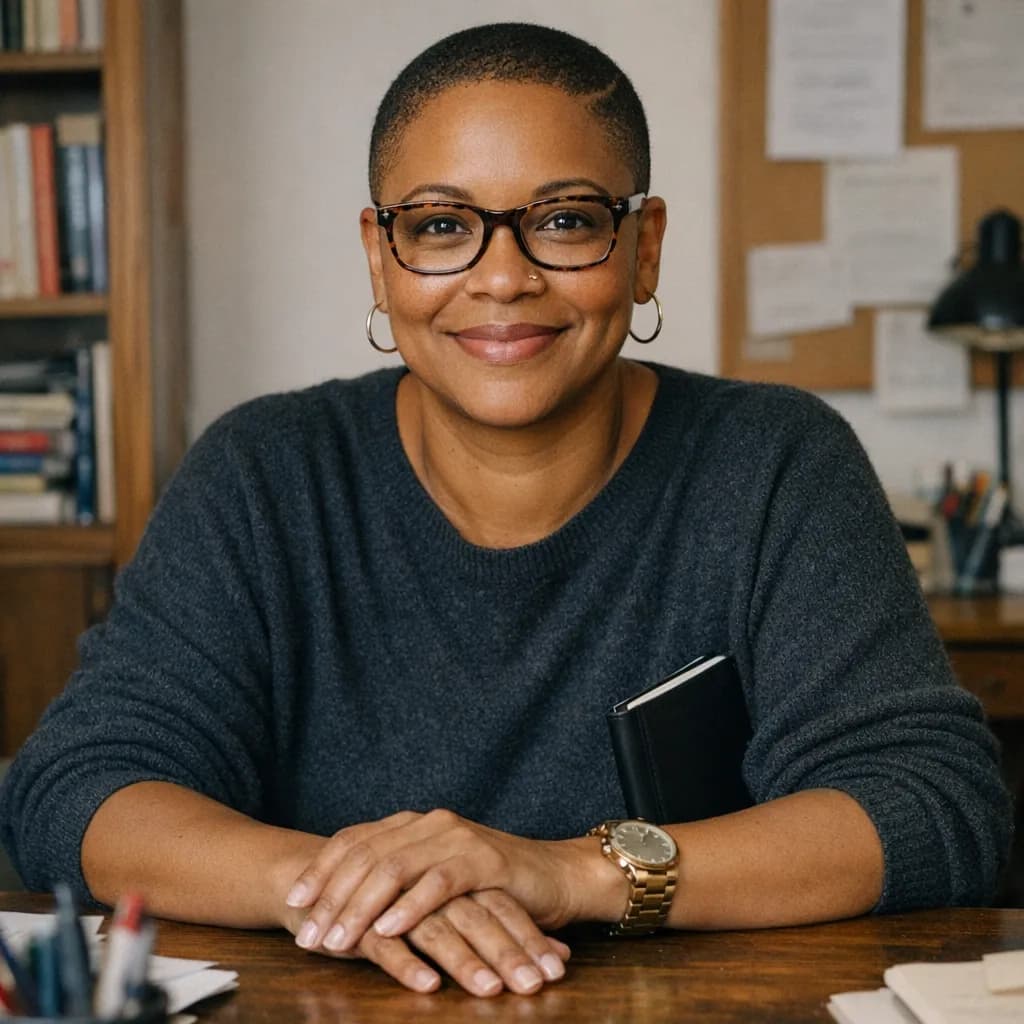
Danae Marcelline Brooks
Developmental Fiction Editor & Manuscript CoachI grew up between church basements, tidewater heat, and people who could tell a whole family story while stirring a pot and never looking up. My mom kept paperback romances in a shoebox like they were contraband, and my aunt kept a shelf of mystery novels with cracked spines. I read both. I learned early that readers forgive a lot, but they don’t forgive being bored or being lied to. I didn’t come up dreaming about editing. I wanted steadier work than “writer,” and I was the kid who could take notes fast, so I ended up in admin jobs where I got volunteered into fixing other people’s documents. Outside of that, I spent a couple years doing hair out of a friend’s kitchen. That part of my life doesn’t explain my editing, but it’s true: I still remember the sound of a cape snapping and how people tell you the most pointed truths when they think you’re not allowed to answer back. Sometimes I miss that kind of honesty. A storm took out power for a week when I was in my late twenties, and I agreed to help a neighbor organize a stack of workshop pages because there wasn’t much else to do at night. The pages were a mess, but the voice was alive. I wrote margin notes the way I talk, not the way school taught me, and the neighbor asked for more. That turned into being the person people handed drafts to. I still carry this old belief that if you “work hard enough,” the story will behave. I don’t defend it, but I catch myself acting like it’s true when I see a writer piling scenes on top of scenes. Now I’m a developmental editor because I’m impatient with pretty sentences that protect a story from making decisions. My bias is I’ll side-eye passive main characters harder than most editors will, even when the genre gives them excuses. I don’t correct that. It’s the lens I read through, and writers who want a gentler read should pick someone else. If you want a first reader who will point at the exact scene where your book starts dodging consequences, I’m your person.
Frequently Asked Questions
- What makes My Name Is Red so compelling?
- Many readers assume the book grips you because it blends a murder mystery with historical detail. It grips you because it turns interpretation into danger: every character must explain art, faith, and desire in a way that keeps them alive. Pamuk makes “style” function like evidence, so beauty stops being decoration and starts becoming risk. If you want a similar pull in your own work, track what each scene forces someone to decide, not what each scene allows you to describe.
- How does Orhan Pamuk use multiple narrators effectively in My Name Is Red?
- A common rule says multiple narrators add variety, so you should rotate voices to avoid boredom. Pamuk rotates voices to intensify conflict: each narrator brings a competing theory of truth, guilt, and piety, and each voice tries to control the reader’s verdict. He also keeps chapters mission-driven, so a new voice does not pause the plot; it re-aims it. When you attempt this, give every narrator a stake that changes what they risk by speaking.
- What themes are explored in My Name Is Red?
- People often label the themes as “East vs. West” or “tradition vs. modernity,” then stop there. Pamuk goes narrower and sharper: he examines authorship, anonymity, and whether artistic individuality counts as pride or honesty. He also tests how love behaves when social structures treat it like a negotiation tool. Themes stick when characters pay for them in choices, so as you write, tie every abstract idea to a concrete consequence someone cannot dodge.
- How long is My Name Is Red?
- A quick assumption says length only matters for pacing, so you can ignore it as long as chapters feel “immersive.” My Name Is Red runs long in most editions (often around 600+ pages in English), and Pamuk uses that space to layer competing testimonies and let ideas evolve through repeated, pressured scenes. If you write something similar, do not pad. Use length to change the reader’s understanding over time, not to repeat the same point with new costumes.
- Is My Name Is Red appropriate for all readers?
- Some assume any acclaimed novel works for everyone if they “stick with it.” Pamuk asks for patience with cultural context, religious debate, and a deliberately braided structure, and he includes violence tied to the central mystery. The payoff comes if you enjoy arguments embedded in story, not just plot velocity. As a writer, treat “appropriateness” as a promise about reading experience: set expectations early through tone, not through disclaimers.
- How do I write a book like My Name Is Red?
- The tempting misconception says you can replicate the effect by copying the surface features: historical setting, murder plot, and many narrators. Pamuk’s real method links form to stakes: he makes voice selection a moral act, and he makes craft knowledge drive the investigation. Start by choosing one profession or art where technique creates identity, then design a conflict where identity becomes incriminating. After that, police every chapter for consequence: each voice must change what the next scene can do.
About Orhan Pamuk
Use trustworthy objects (a photo, a receipt, a museum label) to anchor a slippery narrator, and make readers doubt their own certainty while they keep turning pages.
Orhan Pamuk writes novels that feel like private arguments with the reader. He builds meaning by making you hold two truths at once: the story works as a plot, but it also keeps asking who gets to tell it, who gets believed, and what a "fact" even means inside a life. He doesn't deliver a thesis. He stages a slow negotiation between desire, shame, pride, nostalgia, and the need to be seen.
On the page, Pamuk controls psychology through permission and doubt. He gives you intimate access—confessions, memories, small sensory proofs—then slips in an angle that changes how you interpret what you just accepted. He uses artifacts (photos, paintings, notebooks, museum objects, street names) as credibility anchors. Once you trust the object, he can bend the narrator.
The technical difficulty hides in his calmness. The voice sounds straightforward, even chatty, while the structure does the heavy lifting: nested stories, strategic digressions, delayed revelations, and perspective shifts that reframe earlier scenes. If you copy the surface—melancholy, Istanbul, philosophical asides—you'll get a flat travel diary. The engine is architectural, not decorative.
Modern writers should study him because he proved you can write intellectually ambitious fiction with page-turning compulsion, without turning the book into a lecture. He plans like a builder: motifs recur, objects return with new meaning, and the narrator's credibility changes by design. He drafts to discover voice, then revises to tighten the pattern—so the "wandering" always lands somewhere earned.











Ready to improve your draft with direction?
Open Draftly, bring your draft, and move from stuck to a stronger draft without losing your voice. Editors are on standby when you want a deeper pass.
Free welcome credits included. No credit card needed.