War
Book Summary & Analysis
Book summary and writing analysis of War by Sebastian Junger.
“War” works because it refuses the lazy promise most writers make: that “danger” automatically creates drama. Junger builds drama from a tighter engine: a small group of men who need one another to survive, and who also crave the intense belonging that survival requires. Your central dramatic question doesn’t sound like a movie trailer. It sounds like a private, writerly dare: what does combat do to a person’s sense of meaning—and what happens when that meaning becomes addictive?
The setting stays concrete and constrained: 2007–2008, the Korengal Valley in eastern Afghanistan, with outposts and ridgelines that force short horizons and repetitive routines. Junger places himself with Second Platoon, Battle Company, 2nd Battalion, 503rd Infantry Regiment of the 173rd Airborne. The protagonist functions as the collective “platoon” (with recurring faces like Sergeant First Class Dan Kearney, Specialist Brendan O’Byrne, and soldiers such as O’Byrne’s friend and fellow fighters), while the primary opposing force takes two forms: the Taliban’s constant pressure and the valley itself, which turns every movement into exposure.
The inciting incident doesn’t need a single theatrical “call to adventure” because the book uses immersion reporting, not a hero’s-journey plot. Still, you can point to the moment Junger embeds and commits to staying through repeated firefights—especially early patrols that escalate into contact and show him, fast, that the platoon’s day-to-day baseline already includes lethal risk. He makes a specific choice that matters for craft: he stops acting like a tourist of violence and starts tracking the social economy of the unit. If you imitate the book naïvely, you’ll copy the gunfire and miss the actual turn.
Stakes escalate structurally through tightening circles. First circle: staying alive on patrol. Second: not getting your friends killed through a mistake, hesitation, or ego. Third: what happens after deployment, when the war ends but the need for the group doesn’t. Junger keeps increasing cost by shifting the question from “Will they survive this?” to “What kind of person will survival require them to become?” and then, cruelly, “Can they live with that person afterward?”
He also escalates by varying distance. He gives you close-up scenes of contact—confusion, shouting, tracer lines, the body’s pure math of cover—and then he pulls back into analysis: why men fight, what fear does, how honor and shame operate, why modern societies struggle to reintegrate warriors. That expansion-and-contraction rhythm lets him raise the stakes without inventing melodrama. The book’s pressure comes from contrast: the ordinary (boredom, jokes, cigarettes, gear checks) rubbing against the sudden extraordinary (incoming fire, casualties, grief).
The opposing force stays credible because it rarely turns into a cartoon villain. The Taliban appears as an ever-present threat, but Junger keeps the real antagonist closer: probability. An IED doesn’t hate you. A ridge line doesn’t care. A bullet doesn’t carry a moral argument. That choice protects the book from propaganda and gives you a cleaner craft lesson: you don’t need a sneering bad guy if you can personify the environment and the consequences.
The book’s structure culminates not in a single “final battle” but in a moral and emotional reckoning. Losses hit, bonds deepen, and the platoon’s identity hardens under pressure—then Junger widens the lens to the cost of coming home. That last escalation surprises readers who expected a combat chronicle. It lands because he prepared it all along: every scene of brotherhood also plants the seed of absence.
If you try to imitate “War” by stacking action scenes, you’ll produce noise. Junger earns intensity by showing what the men protect besides their bodies: status, competence, loyalty, and the right not to be a burden. He makes fear social. He makes courage relational. Copy that engine and you can write “war” in any setting—start-up trenches, hospitals, kitchens, sports, family care—anywhere a group faces consequence together and can’t afford a weak link.
Story Structure & Narrative Arc
Story structure and emotional arc in War.
The emotional trajectory runs as a subversive Man-in-a-Hole with a twist: the deeper the danger, the higher the internal “fortune” climbs, because belonging feels like salvation. The platoon (as a collective protagonist) starts wary, hungry for competence and acceptance, and ends welded by shared risk—then faces the quiet damage of losing that tribe.
Key sentiment shifts land because Junger toggles between terror and fellowship without sentimentalizing either. High points arrive in the middle of firefights when coordination clicks and the group functions as one mind; low points arrive after, when casualties and exhaustion force meaning to show its price. The climactic force doesn’t come from a single set-piece; it comes from accumulated proof that the thing that keeps them alive can also make ordinary life feel thin.

Studying this book—and stuck on your pages?
Put your draft in Draftly. Fix scenes and dialogue in the text—not in another tab. When you want sharper feedback, AI editors are ready.
Free welcome credits included. No credit card needed.Writing Lessons from War
What writers can learn from Sebastian Junger in War.
Junger’s first trick looks simple but most writers dodge it: he treats the unit as the protagonist and lets individual men surface as facets of one organism. That choice solves a structural problem that kills many war books: too many names, not enough narrative spine. By returning again and again to the platoon’s shared needs—competence, loyalty, status, protection—he creates continuity without forcing a single hero’s arc onto a collective experience.
He writes action with a reporter’s clarity and a novelist’s pacing. He anchors danger in sensory logistics—distance, cover, lines of sight, radio calls—so you feel how decisions happen, not just that they happen. Then he earns the right to generalize. He’ll give you a specific scene of contact, then widen to psychology and anthropology without sounding like a TED talk because he has already paid in concrete detail.
Watch his use of dialogue and banter as moral architecture, not decoration. When soldiers like Dan Kearney and Brendan O’Byrne trade blunt assessments and dark jokes, they negotiate hierarchy and fear in real time; they police weakness and offer belonging in the same breath. Many modern books “quote” dialogue as flavor. Junger uses it as a pressure valve and a sorting mechanism: who can take it, who breaks, who earns respect, who needs covering.
Atmosphere comes from constraint, not lyricism. He gives you the Korengal’s steep ridges, exposed trails, and the claustrophobia of small outposts where everyone hears everything and privacy dies fast. That physical layout becomes a moral layout: nowhere to hide, nowhere to opt out, nowhere to be purely yourself. Writers often reach for big themes (“the futility of war”) and forget place. Junger reverses it. He builds theme from geography, routine, and consequence until the idea feels inevitable.
How to Write Like Sebastian Junger
Writing tips inspired by Sebastian Junger's War.
If you want Junger’s voice, stop trying to sound brave. He writes clean sentences that tolerate silence. He avoids the performance of outrage and the performance of awe. He lets the facts carry the sting, and he saves his strongest judgments for places where the reader already sits in the scene. Draft your first pass plain, almost spare. Then revise for precision, not intensity. If you add adjectives to force emotion, you admit you didn’t earn it.
Build characters through role under stress, not backstory. In this book, you learn people by watching what the group relies on them for, and what the group won’t forgive. Give each core figure a job the story can test: calm under fire, tactical imagination, humor that steadies others, recklessness that risks the team. Then stage moments where that strength turns into a liability. Development shows up when the group’s needs change and the person has to adapt.
Avoid the genre trap of making combat the point. Many writers stack firefights like set pieces and call it authenticity. Junger treats combat as a revealer: it exposes status games, loyalty, shame, tenderness, and the hunger for meaning. He also refuses easy villains and easy saints, which keeps the moral frame complex without getting vague. If you feel tempted to “explain the message,” put the message back into consequence. Make a choice cost something now, not in an abstract afterword.
Try this exercise. Write one high-risk scene twice. Version one stays inside pure logistics: who stands where, what they see, what they can’t see, what they do next, and what it costs in time and exposure. Version two removes almost all action and focuses on the five minutes after: the jokes, the anger, the quiet, the small repairs, the glance that checks if someone’s okay. Then write a short reflective bridge that generalizes one insight, but only using terms the scene already proved.
Who Would Edit This Book?
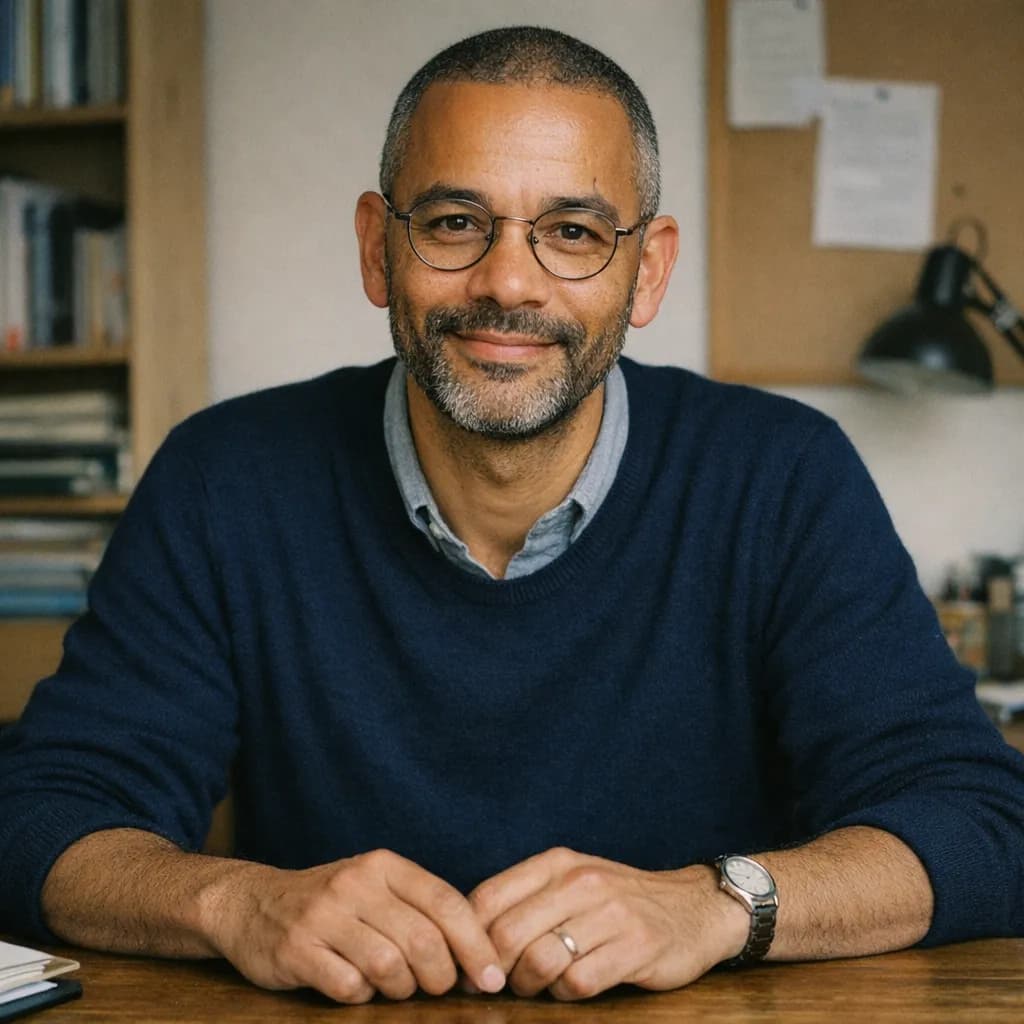
Alistair Rowan McEwan
Developmental Editor and Non-Fiction Manuscript CoachI grew up between Leeds and Glasgow, in that half-and-half way where you’re never fully from one place, so you learn to listen for what people mean instead of what they say. My mum kept old paperbacks and my dad kept newspapers, and I read both with the same suspicion. I still hear my gran’s voice when I write notes: she’d tap the page and say, “Aye, but what made that happen?” At nineteen I worked nights stacking shelves and days in a dull admin job for a small training provider, mostly because rent doesn’t care about your plans. They had me tidying course handouts and “improving the flow,” which meant cutting waffle and moving sections around until the trainer could teach without apologising. Around that time I got obsessed with making the perfect chilli recipe and kept a notebook of tiny tweaks. It didn’t make me a better editor, but I still do it, and I still overreact when a list of ingredients comes before the method. I didn’t set out to be an editor. A friend needed a second pair of eyes on a grant application, then another person asked, then a whole department started sliding documents onto my desk because I’d tell them the truth without making it personal. Later, I ended up in a communications role after a reorg - pure convenience - and I started doing beta-style reads for people writing practical books and narrative non-fiction on the side. Now I work with authors who want a manuscript that can survive a hard reader. I’m calm about most things, but I’m stubborn about causality: if a chapter claims a result, I want to see the choice that led there, and what it cost. I know my bias: I don’t spend long admiring lyrical voice if the argument is dodging responsibility. I’m the person you hand the draft to when you want the first reader who says, “This part doesn’t earn its conclusion,” and then shows you where it went off the rails.
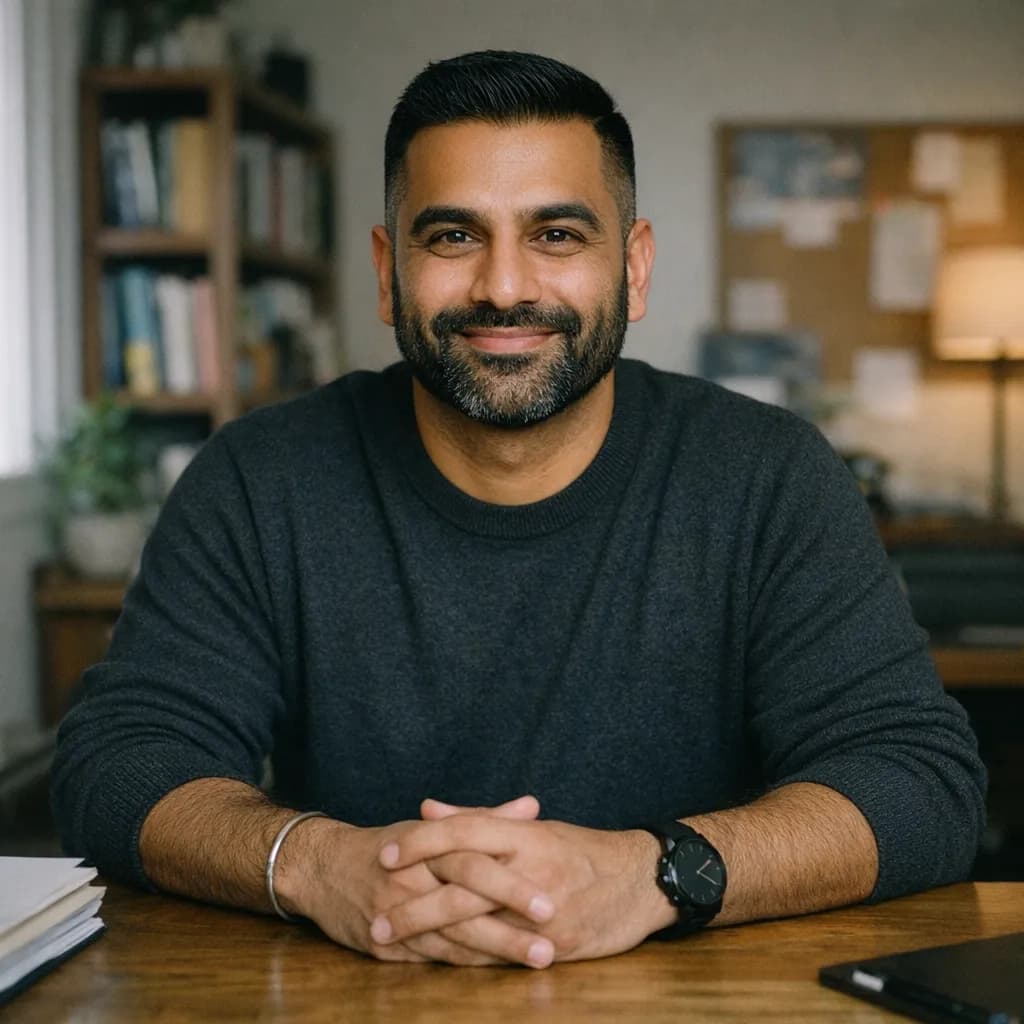
Arjunveer “Arj” Sandhu
Nonfiction Manuscript Editor & Writing Coach (Generalist)I grew up between Punjabi at home and English everywhere else, which taught me early that “I understood it” and “it was said clearly” aren’t the same thing. My dad ran a small trucking outfit and kept every receipt like it was scripture. My mom read Punjabi poetry and refused to explain it. I landed in the middle: I like meaning you can point to, and I don’t trust pretty fog. I didn’t plan on editing. I studied business because it was easy to explain at family dinners, then worked jobs where nobody had time for long sentences - operations, training docs, policy rewrites. I took a night improv course once because a friend wouldn’t go alone. I was bad at it. I still keep the ticket stub like it proves something. I started giving notes because people kept sending drafts with “can you make this make sense?” and I didn’t know how to say no. A supervisor once handed me a 40-page internal guide and said, “Fix it by Friday or we get audited.” That deadline became a habit: I read fast, I mark the real breaks, and I don’t pretend confusion is a personality trait. I’m harsher on fuzzy claims than clunky style, and I’m not interested in correcting that. Now I work with authors who want a first reader who won’t protect feelings at the expense of the book. I still ask, “What are you promising me in the first ten pages?” I don’t care if your voice is charming if your logic cheats. If your structure is designed to wander on purpose, I’m probably not your best match.
Frequently Asked Questions
- What makes War by Sebastian Junger so compelling?
- Most people assume combat narratives work because danger guarantees suspense. Junger proves a sharper rule: danger only matters when you attach it to belonging, competence, and the fear of failing your group. He keeps scenes concrete and then earns reflection, so you feel both the body-level stakes and the meaning-level stakes. When you study it, keep asking what each scene changes inside the social unit, not just what happens on the ridge.
- How long is War by Sebastian Junger?
- Writers often assume length matters less than “pace,” and that’s mostly true. War runs about 300 pages in many editions (often around 288–320 depending on format), but it reads fast because Junger alternates short, high-clarity scenes with tight analysis. If you want to emulate the experience, focus on compression: make every paragraph either advance a lived moment or cash out a specific insight the moment earned.
- Is War by Sebastian Junger a novel or nonfiction?
- A common misconception says nonfiction can’t teach narrative craft because it “just reports.” War sits firmly in nonfiction reportage, but it uses many novelistic tools: scene selection, recurring characters, controlled escalation, and thematic payoffs. Junger doesn’t invent events; he shapes meaning through structure and juxtaposition. When you borrow from it, borrow the architecture—how he orders experience—not the surface style of grit.
- What themes are explored in War by Sebastian Junger?
- People often reduce the book to a single theme like “the horror of war.” Junger goes narrower and more unsettling: he explores brotherhood, meaning, status, courage as a social act, and the difficulty of returning to a society that can’t replicate the tribe. He also examines randomness and the moral weight of small decisions under pressure. As a writer, track how each theme emerges from a scene rather than from explanation alone.
- How do I write a book like War by Sebastian Junger?
- The standard advice says, “Make it intense, make it real, show the danger.” That advice produces overwriting and empty theatrics. Instead, build a tight container (a unit, a crew, a ward, a team), define what membership costs, and let risk test competence and loyalty in public. Then alternate scene and reflection, but only after you’ve earned authority through specificity. Revise by removing any line that tries to impress instead of clarify.
- Is War by Sebastian Junger appropriate for all readers?
- Many assume any war book automatically counts as mature content, which often holds. War includes graphic violence, trauma, and frank soldier talk, but Junger doesn’t fetishize gore; he treats it as consequence and context. Sensitivity depends on the reader’s experience with loss and combat, not just age. If you write in this space, use restraint: put the harshest details where they change understanding, not where they merely shock.
About Sebastian Junger
Pressure-test a scene, then place one hard fact where it will land. Stakes register without being announced.
The Andrea Gail went down with all hands. Six men went out of Gloucester for the Grand Banks, the boat was lost, and the last anyone heard from it was a radio call about the weather. Sebastian Junger wrote the hours after that call anyway, and The Perfect Storm is worth studying for how openly he does it: he tells the reader where the record stops, then rebuilds the rest out of weather data, radio traffic, and interviews with men who had lived through comparable water, marking each inference with a verb that admits it.
The later books put the same lathe on different material. War places him with one platoon in the Korengal Valley. A Death in Belmont lays out two cases against two men and convicts neither. Tribe leaves the fighting and asks why the homecoming is worse. In My Time of Dying turns the instrument on his own body.
What you can recognise on the page is the order of things. A scene raises a question, the reader feels it, and only then does the background arrive, sized to that question and no wider. Detail earns its place by being able to fail: rope, weather, a generator, a knee. Emotion words stay rare, because the body has already reported.
Study him for the sequencing rather than for the toughness. His books are the clearest modern demonstration that suspense in reported prose comes from what a writer holds back and when he lets it go.











Ready to improve your draft with direction?
Open Draftly, bring your draft, and move from stuck to a stronger draft without losing your voice. Editors are on standby when you want a deeper pass.
Free welcome credits included. No credit card needed.